
The ongoing West Asia conflict is expected to severely impact the supply of affordable housing in India, as rising input costs further erode already thin developer margins. Fluctuations in crude oil and gas prices, coupled with higher freight costs, are driving up prices of essential construction materials like cement and steel, making new projects increasingly unviable for developers.

The company is also exploring the markets of Bangalore, Nashik, Panvel, Thane and Pune among other cities for the same.

Developers are entering one of the busiest construction cycles, with the top four firms planning launches worth Rs 1.13 trillion over the near to medium term, even as execution faces pressure from approval delays, labour shortages, rising costs, and contractor capacity limits across the industry.

The government's Budget announcements providing tax holiday for data centres, setting up of city economic regions (CERs) and funding to improve infrastructure in Tier-II and -III cities may give an indirect boost to India's realty sector, said industry executives.

Real-estate firms have welcomed the Goods and Services Tax Council's reforms, expecting better affordability for buyers, spurring demand. The council has reduced the rate on cement from 28 per cent to 18 per cent, while the rate on sand lime bricks or stone inlay work and granite blocks has been cut to 5 per cent from 12 per cent.

Data centres are increasingly becoming a key part of the real estate landscape, as reality firms - with rich expertise in land acquisition, construction and dealing with government approvals - are seeing them as opportunities to build long-term assets with continuous revenue flow.

Renowned realtors are shying away from the private equity (PE) route to raise funds.
While demand for sub Rs 50-lakh affordable housing prevails, market players cite increased land rates, escalated construction costs and low margins as key prohibiting factors.

Housing demand should improve nationwide after the Reserve Bank of India (RBI) cut the repo rate by a larger-than-expected 50 basis points (bps) on Friday, said real estate industry executives. The rate cut comes after housing sales in top Indian cities in the first quarter of 2025 dipped 28 per cent due to skyrocketing residential property prices and geopolitical headwinds, according to Anarock.

If the talks materialise, this would mark Hyundai's foray into the LNG terminal construction space in India.

Hiranandani Constructions' Managing Director Niranjan Hiranandani feels a 10-15 per cent hike is likely this year in residential properties.

Bangladesh government has shortlisted bidders for a 5-mt LNG terminal at Moheshkhali island in the Bay of Bengal.

Disappointed with the RBI decision of not reducing policy rates, carmakers and real estate players today said the sectors, which are already reeling under a slump, will continue to suffer due to the high interest rate regime.

Farmers too will get better deals

This shift is driven by a pursuit of a superior lifestyle and an innate desire to be grounded in an owned plot of land. Villas, situated within gated housing societies, have gained popularity as a property type, witnessing strong traction due to elevated aspirations and the need for more living space.

'The rising cost of construction, the cost of doing business, high compliance, and inflation/interest rates going up have already reduced returns to single digits.'

'Marginal rates will definitely affect the consumer's decision in entering a new transaction, but in reality, they don't affect much because banks/financial institutions have come up with step-up EMIs: 50% of home loans which exceed 15 years in India are prepaid, within 7-8 years.' 'This doesn't happen anywhere in the world.'

Big Mumbai developers' inventory at Rs 53.4 crore.

India is all set to make its presence felt in the $47 billion global outsourced semiconductor testing and packaging market, an arena where Malaysia and Vietnam have been way ahead so far. The Cabinet last Thursday cleared two projects, the Tata's assembly testing and packaging plant (ATMP) and the Murugappa-owned CG Power with Renesas from Japan as its tech partner. These, together with Micron's assembly and testing plant which is already being constructed in Sanad in Gujarat, will collectively invest Rs 47,300 crore to set up the factories.
Real estate and hospitality major Hiranadani Constructions on Friday said it has plans to set up two Special Economic Zones - one in Powai and the other in the city periphery.
Real estate biggies expcet single window clearance for upcoming projects.

Realty major DLF's chairman Rajiv Singh remains the wealthiest Indian real estate entrepreneur with a wealth of Rs 59,030 crore, according to GROHE-HURUN India. With a wealth of Rs 42,270 crore, Mangal Prabhat Lodha and his family of Mumbai-based Macrotech Developers (Lodha Group) is at the second position. Arjun Menda & family of Bengaluru-based RMZ Corp debuted at the third position on the list, with a wealth of Rs 37,000 crore.
.jpg)
Nearly 40 developers participating in HDFC Indian Homes Fair in London would showcase thousands of property.

Prime Minister Narendra Modi on Wednesday said the world looks at India as an important pillar of stability, a trusted friend, an engine of growth in the global economy, a technology hub for finding solutions and a powerhouse of talented youth. He also said that in the rapidly changing world order, India is moving forward as 'vishwa mitra' (friend of the world). Speaking at the inauguration of the 10th edition of the Vibrant Gujarat Global Summit, which saw participation of state hea

Experts, however, caution that though the moves are positive for the sector as a whole, they don't expect much gain in the near-term.

Shankar Prajapati, a 57-year-old potter in Dharavi, has given up hope of getting a bigger house for his family. He lives cheek by jowl in a hutment measuring 200 square (sq.) feet (ft) in the nondescript shanty town. "We have surrendered to our fate. We cannot wait forever for better accommodation. "Perhaps we are not meant to dream big," despairs Prajapati. Raju Korde, president, Dharavi Redevelopment Committee, and a local resident, agrees with Prajapati.

e of them requires MPs to follow the norms including the Code of Ethics, which mandates them not to take gifts that may interfere with honest and impartial discharge of their official duties.
Discounts could be luring but onus of due diligence is always on buyer
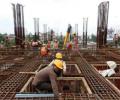
Around 576,000 housing units, worth Rs 4.64 trillion, are delayed in seven major cities of the country

Leading property developers, such as Oberoi Realty, Tata Realty and Infrastructure, and Hiranandani, have turned to redevelopment of existing buildings in the expensive parts of Mumbai as a way of augmenting revenue. Experts estimate that Mumbai's redevelopment projects could be worth Rs 30,000 crore. As such, they are not new. What is new is that the big developers are interested in them. Leading the race is Oberoi Realty, which has set up a separate team for these projects.

Raghavendra Kamath reports on what ails India's real estate sector.

Several on-site labourers in the city want to take special trains being run to transport workers back home. The rising number of COVID-19 cases in the city has caused anxiety among them.

Urban planners and real estate experts say bad town planning in Mumbai and rising deaths during the ongoing pandemic are a "sad reality". Dev Chatterjee and Raghavendra Kamath report.

83% of the CEOS plan to hire more in the new year.

Experts said the builders will now factor in their losses arising from the removal of input tax credit when they pass on the benefits to end users while the latter may want the entire GST cut to be given to them.

Work on projects worth Rs 1,000 cr in full swing: Gift City
The year 2018 is likely to be steady in terms of institutional investment into real estate

Construction costs would be reduced to some extent and this benefit can be passed on to the customers, thereby spurring home buying
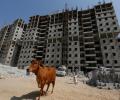
CREDAI-MCHI, a body of developers in Mumbai, has pegged the drop in sales booking at around 80 per cent in the February-March period this year. This is the second highest fall in residential sales in the past five years, after Q1, 2017, when the decline, due to the note ban, was 37 per cent.
